Good quality, professional wedding videos, without fuss or outrageous pricing.
An important notice: For the time being, we are stepping away from filming weddings, hence why most of this page has been greyed-out.
I've been video taping weddings for over twenty years, now. I shoot them to a basic style, where we (optionally) film a bit at both houses before the service, cover the service using two cameras (operated by two people—which are later edited together, in a professional manner—this isn't a home movie), sometimes cover a bit of the action at the photo session, then (optionally) video tape at the reception.
I shoot the day in a documentary type of fashion. Filming what happens, as it happens, with a minimum of interference in what you do (no staging of things, just for the camera). What particular events, and how they're filmed is up to the customer, but there are four basic things that I don't change:
-
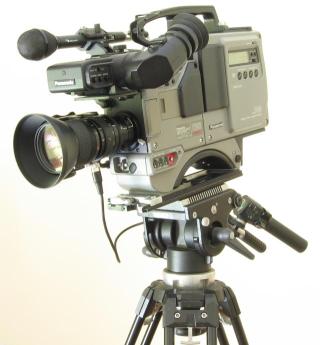
I always use more than one camera (it's too easy to have large sections of filming ruined by events beyond my control if only one camera is used). One camera is used to record the majority of things, with the second camera able to film other points of interest.
-
Videos are edited, afterwards (not in-camera, while filming), combining the two cameras together, with the finished product usually ready in about a week. Please let us know if you need the edited video more urgently than that.
-
I cover the entire service, there are no parts of it missed out. But it's easy enough to also produce a short edited version, to quickly show your friends the highlights of your wedding, after the day of filming. (Additional costs apply.)
-
I cover the highlights of the reception: Entrances and exits, speeches, bridal waltz, guests dancing, etc. We do not film continuously at the reception.
-
I don't use (gimmicky and annoying) special effects.
I keep a master tape, permanently, from which copies can be made at any time in the future (for around $30 depending on the length). This frees you from the worry of what to do if your VCR chews your tape, or your DVD gets ruined.
All of this is included in a $800 or $950 fee (the cheaper price is when we don't film at the houses before the service). It covers the cost of all materials and labour, filming and editing, used in the production of a video in my usual style (variations to the plan may alter the cost). It is a final price, unless you ask for further work to be done.
A $150 deposit is required to confirm a booking. A second pre-payment of $200 will need to be made shortly before the filming date. (These payments are deductions from the total price, not in addition to it.) The balance will be due upon collection of the video, or clients may finish payments on the filming day, if they wish.
We do accept last minute bookings, subject to ability to take on the job, though they may require a higher percentage deposit, and we may not be able to do them at the prices listed on this page.
I can omit certain things (like filming at one or both of the houses, before the service; or the wedding reception, after it). However, filming less things in the middle of the day isn't going to make things any cheaper (because I will still have to be hanging around, unable to do any other work at the same time, use the same number of video tapes, and much of the pricing covers post production work).
Over the years we've filmed plain old Aussie, Italian, Greek, Ukrainian, Indian, Samoan and Lebanese weddings, amongst others, and a deaf wedding conducted mostly in sign language. As long as we know what to film, we can film it. Get in touch with us to discuss your wedding video.
| Price | Valid at | Coverage |
|---|---|---|
| $800 | 21 January 2009 | wedding service & reception package |
| $950 | 21 January 2009 | both houses, wedding service, & reception package |
NB:
-
Prices are subject to change without notice on the website. But, subject to the economy not changing radically when a job's been booked ages in advance, and subject to clients not changing the job requirements, prices don't change once a job is booked.
-
Country (or other long distance) weddings will cost more than listed prices, due to the additional costs involved in travelling long distances. Please tell us location details so we can give you a customised quote. We cannot do all long distance wedding jobs, it'll depend on the location, and the willingness of crew to participate. Enquiries will need to be made well in advance, and it may take a while before we can say if we can take on the job.
-
Yes, we do have demonstration videos that you can see, but we don't post them out, nor do we put them on the internet where they could be subject to abuse. You'll need to pay us a visit.
-
If you're of a religion that practices segregation of the men and women, please ask someone else to film your wedding. We don't do segregation in this country. I find that I'm endlessly running back and forth filming between two rooms. And it's clear that the women do not want to be filmed, no matter how many times someone else tells me to film them.
-
Outdoor filming cannot be done in the rain.
-
We won't do filming on beaches. It only takes one grain of sand to be blown into the equipment, into the wrong place, to totally ruin it.
-
Strong wind can severely affect the sound. We can film in the wind, I just feel it's fair to say it's harder to get good sound under those conditions.
-
Filming under very low light conditions produces poor results. Though I've never, yet, had to use extra lighting in a church, some reception halls have been difficult to film in. And if you have the lights dimmed too much, you won't get anything good on video. You'll need to have them raised a bit for the special parts of the reception (cake cutting, bridal waltz, speeches, etc.).
-
Setting up time is required before beginning filming at each location (i.e. I need to be in the church about 20–30 minutes before the event, likewise for all other locations). We have to get there before you, park, unload gear, get into the place, carry all the gear in, find a good place to set up, and finally set up the gear. There's a lot to do, and it takes time. Clients expecting us to get started in just a few moments before they arrive may find that a good proportion of the service will not get filmed, at all, and what does get filmed gets done badly. You need to plan a delay in driving from your house to the church, that lets us get there ahead of you with plenty of time to spare.
-
We do not give out the un-edited camera tapes. But you're not missing out on anything, you do get to see the whole event, the best points of view of it. While one camera is filming the shot that we're going to use, the other camera roves about and sets up the next shot, then the two cameras swap roles (now the first camera sets up for the next shot, while the second one is filming). They take turns filming, in this manner, during the service and the reception. Other parts of the day, that don't really need two-camera coverage, may be filmed with just one camera. And other than set-up and waiting time (where the camera may be started filming ahead of time, waiting for some thing to happen, so that we don't miss the start of it), we don't film things that aren't going to be in the final edited video. The un-used vision isn't intended to be seen, and isn't something that you'd want to watch.
-
The average Australian wedding video runs from about 90 minutes to just under two hours. It usually includes; the bride arriving at the church, walking down the aisle, the entire service, exiting the church, the gathering outside the church doors, driving away from the church, arriving at the reception, cutting the cake, speeches, bridal waltz, throwing of the bouquet and garter, some dancing and partying, and leaving the reception.
It may also include; some of the getting ready at the houses before going to the church, some of the photographer taking your photos between the service and reception, and shots of the guests at your reception; it depends on what we're asked to do, and whether anything happens that's worth filming.
Typically, we find that there isn't much worth filming at the houses, beforehand. A few people doing their hair, getting dressed, and panicking about how everything is going, doesn't usually make for good video; though a house full of celebrating relatives, does. Likewise, it's hard to make a bunch of people being posed in different places by the photographer, but not actually doing anything else, look good on video.
There's a couple of options about that: Don't include any boring stuff in the video, and keep the running time of the video down to a reasonable length. Or, include it, and try to make it less boring by covering it with music (which doesn't really make it less boring to watch).
-
Anywhere that I've mentioned “church” mainly refers to the wedding service. It also applies to services held anywhere else that isn't a church.
-
We offer fixed package prices because we have over twenty years of experience in knowing the amount of work that's involved to do a good job. I'm not interested in doing cut-price work, it looks bad, and it makes my job harder. By way of example, I offer this story about a client who took cost-cutting too far. The job suffered, and there's no recovering from it.